HighLights:

Daniel Augusto da Silva Network
The Daniel Augusto da Silva Network is a programme to support small-scale, intensive research collaborations, bringing together carefully selected groups of researchers to work on ambitious mathematical problems.

CIM Bulletin
{{magazine.full_name}}
Pedro Nunes' Lecture
2025
Hugo Duminil-Copin (University of Geneva & IHES)
Michael Christ (University of California, Berkeley)
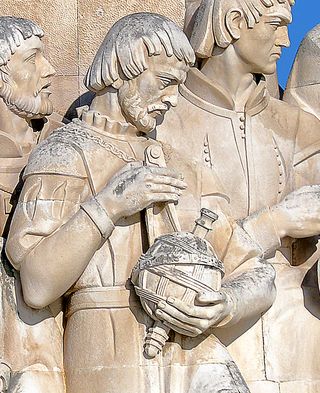
Effigy of Pedro Nunes (1502-1578), a Portuguese mathematician and cosmographer, in the Padrão dos Descobrimentos (Monument to the Discoveries), in Lisbon, Portugal.
Next Events
About CIM
CIM (International Center for Mathematics) is a not-for-profit, privately-run association that aims at developing and promoting research in Mathematics. At present CIM has twenty one associates, including three Portuguese Universities, fourteen Research Centres in the Mathematical Sciences, one Institute, and three national scientific societies.
CIM is responsible for two scientific publications, which are constantly open to the community for contributions:
- Series in Mathematical Sciences by Springer
- CIM Bulletin
The main activities of CIM include sponsoring events, organizing lectures for the community, and awarding the CIM Medal:
- Events sponsored by CIM
- Pedro Nunes Lectures
- CIM Medals
CIM is a member of ERCOM - European Research Centres on Mathematics and of IMSI - International Mathematical Sciences Institutes.