Daniel Augusto da Silva
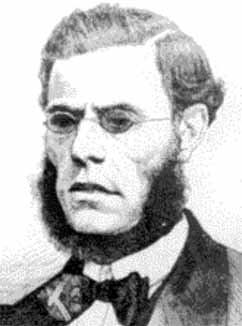
Daniel Augusto da Silva (1814–1878) was a brilliant 19th-century Portuguese scientist and mathematician, whose research contributed to advances in Pure Mathematics, Physics, Chemistry, Statistics and Actuarial Sciences.
One of his main works, on the resolution of modular congruences [*], introduced foundational concepts in set theory and a pillar of enumerative combinatorics: the Principle of Inclusion-Exclusion. Although he was working in relative isolation, this memoire laid the seeds of Discrete Mathematics, a field which lies at the foundations of modern computer science, cryptography, and digital communication.
As a naval officer and a member of the Lisbon Academy of Sciences since 1850, he is also known for one of the first studies of the Portuguese demography, then applied to the financial structuring of pension funds of one of the oldest Portuguese banks, Montepio Geral.
The Daniel Augusto da Silva network, based in Portugal, aims to foster international collaboration, promote cutting-edge research in all fields of mathematics and of its applications, and ensure that the legacy of pioneers like Daniel Augusto da Silva continues to inspire the spirit of mathematical discovery that transcends borders and languages.
We refer the reader to the Portuguese Navy’s webpage, which contains a comprehensive list of the works of Daniel Augusto da Silva, together with links to digital copies available online and information on the location of the surviving printed copies: https://www.marinha.pt/pt/a-marinha/historia/personalidades-ilustres/Paginas/Daniel-Augusto-da-Silva.aspx
[*] - Daniel A. da Silva, Propriedades geraes e resolução directa das congruencias binomias - Introdução ao estudo da theoria dos numeros, Real Academia das Ciências de Lisboa, (1854).
Other References:
- https://mathshistory.st-andrews.ac.uk/Biographies/Da_Silva/
- https://www.cim.pt/magazines/bulletin/2/article/17/pdf
- https://repositorio.ulisboa.pt/entities/publication/5113c259-da3c-42b4-9a4f-58357214063f
- https://www.cvc.instituto-camoes.pt/ciencia/p26.html
- https://en.wikipedia.org/wiki/Daniel_da_Silva_(mathematician)